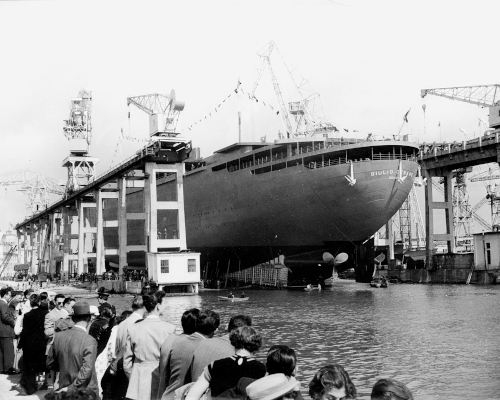
The Monfalcone shipyard, which still today builds many of the largest and most modern next-generation cruise ships commissioned by the world’s most prestigious shipowners, was founded in 1908.
Everything began thanks to an important shipowning family of Lussino origins, the Cosulich family, which moved to Trieste at the end of the 19th century and strongly contributed to the development of transatlantic passenger and freight services between the Upper Adriatic and the Americas. A combination of events, including the devaluation of the Austrian florin against the pound sterling, the introduction of a law subsidising merchant ship construction, and an agreement with the Italian government allowing ships to dock in Italian ports to embark emigrants, led the Cosulich brothers in 1907 to decide to build their own shipyard.
At the time, the available areas in Trieste were already occupied by the San Marco shipyard and the Arsenal. However, the friendship between Alberto Cosulich and his former schoolmate Alberto Rebulla, then mayor of Monfalcone, led to the purchase of a large plot of land in the Panzano area, a marshy zone between the town and the sea. There, in a very short time, the shipyard was built, which today remains the most important producer of cruise liners for American shipowners, a flagship of national industry that brings substantial foreign revenue into the Italian state and provides employment for thousands of people, both directly and through its supply chain.
The foresight of the Cosulich family in choosing the site undoubtedly contributed to its continued success. Located close to major road and rail transport routes, yet sufficiently far from the city centre to avoid conflicts with urban development, the facility never suffered the issues that led to the closure of the San Marco and San Rocco shipyards.
Furthermore, the extensive surrounding undeveloped areas have always allowed for significant expansion at any time (as indeed occurred over the years).
With the first shareholders’ meeting, the shipyard officially opened on 3 April 1908 under the name Cantiere Navale Triestino, reflecting its strong connection with Trieste (until the end of the Second World War, Monfalcone belonged to the province of Trieste rather than Gorizia).
FROM THE EARLY YEARS TO THE SECOND WORLD WAR
The first management of the shipyard was entrusted to several Scottish engineers from the Russell & Co. shipyard in Port Glasgow, where the Cosulich family had previously commissioned most of their transatlantic liners, including the large twin-funnel, twin-screw steamship Martha Washington.
James Stewart was the first technical director of the facility and supervised the construction of the first steamship, Trieste, delivered on 18 February 1909 to the shipping company Dalmatia of
Ragusa (today Dubrovnik). Just one year later, on 15 April 1910, construction began on the first major transatlantic liner for the Cosulich Austrian Navigation Union, which was launched on 9 September 1911 under the name Kaiser Franz Joseph I.
The outbreak of the First World War caused the complete devastation of the shipyard, preventing the completion of three even larger transatlantic liners that were at various stages of construction when the conflict began. In particular, hull no. 39 (which would likely have been named Kaiserin Elisabeth) was a magnificent three-funnel liner with particularly luxurious first-class accommodation and represented a development of the earlier Kaiser Franz Joseph I. The vessel, which was due to enter service in spring 1916, was nearly ready for launch when the war broke out. Positioned directly on the front line, it was bombarded by both sides of the conflict and, once hostilities ended, was repurposed as office space for the shipyard administration until reconstruction could take place.
Once again, the initiative and foresight of the Cosulich family enabled the shipyard to rise again, making it larger and more modern than before and diversifying production to such an extent that it became known as a “large factory”. Aircraft, trains, lorries, buses, railway bridges, electrical equipment, as well as high-quality furniture, household goods, cookware, and more were all produced in the shipyard workshops.
During the bleak immediate post-war period, the Cosulich family and the shipyard management also worked to create a modern workers’ town, which became a remarkable example of class cooperation and understanding between employers and workers aimed at achieving shared goals of growth and well-being. Social facilities included a large theatre, sports facilities, nurseries, schools, medical clinics, shops, farming and livestock activities, making the shipyard community self-sufficient in all essential needs.
In the interwar years, the shipyard experienced one of its greatest periods of international expansion. As stated in a contemporary Cosulich Group publication: «One of the indicators of the technical and organisational excellence achieved by a shipyard is its ability to secure work abroad. It is in the free international market that the major competitive battles between the world’s leading shipyards are fought, from which only those that combine competitive pricing with extensive experience and deep technical and construction capability can emerge victorious.» As a result, medium and large passenger ships were built for Spain, Portugal, the Soviet Union, Poland, Sweden, Brazil, and merchant vessels for much of the world, including the United States and the United Kingdom.
The international success of the shipyard stemmed from the construction of Saturnia and Vulcania. Ordered in 1924 to keep pace with the new vessels of rival companies Navigazione Generale Italiana and Lloyd Sabaudo, both based in Genoa, they stood out for their high level of craftsmanship, their success in the cruise sector enabled by the introduction — on a passenger ship for the first time — of an entire deck of cabins with
private balconies, and above all for their diesel propulsion, which represented a valid alternative to traditional steam power: a smaller engine room requiring half the crew, fuel consumption reduced to one third for the same power output, and far quicker, more precise manoeuvring response.
Saturnia and Vulcania also anticipated the external design of post-war liners: a single central funnel, wide and low, replacing the tall, slender “smokestacks” of steamships, making the ship instantly recognisable to the public as “the ship that does not smoke”.
Unlike other shipyards, Monfalcone continued to receive commercial orders until the outbreak of the Second World War. After completing the first Polish liners built from scratch in the mid-1930s (Batory and Piłsudski), the shipyard won the international competition for the new Swedish flagship Stockholm, a new Ausonia for Adriatica of Venice, and was preparing to lay down what was referred to as the “Super Victoria” for Lloyd Triestino. The latter was never built. The Ausonia, sunk during a 1944 bombing raid, was later salvaged and completed as Esperia. The beautiful Stockholm, which due to a fire had to be rebuilt and was only completed in July 1941, remained laid up in Trieste. After being purchased by the Italia company and renamed Sabaudia, it was destroyed in a 1944 bombing and subsequently scrapped at the San Marco shipyard.
THE SECOND WORLD WAR, REBIRTH AND GROWTH
After being razed to the ground once again during the Second World War, the shipyard was rebuilt and focused primarily on constructing large passenger ships to replace those lost during the conflict and to meet the demands of a new wave of migration. The motor vessel Giulio Cesare, launched in 1950, was Italy’s first post-war ocean liner. It was followed by new vessels for Lloyd Triestino, culminating in the magnificent sister ships Galileo Galilei and Guglielmo Marconi, the last liners of the historic company and the largest, fastest and most luxurious it ever operated.
As scheduled passenger services declined during the 1960s under increasing competition from air travel, Monfalcone built the prototype of the modern cruise ship: Oceanic, which entered service in 1965. Still sailing today, it stands as a testament to the exceptional quality of Monfalcone’s shipbuilding.
The following year, amid the oil crisis and the difficult years of the Cold War, the delivery of Eugenio C. brought the era of the transatlantic liners to a close. For more than twenty years, no passenger ships were built in Italy. Having become part of the Italcantieri Group, Monfalcone survived, despite a reduced workload, by concentrating mainly on the construction of massive bulk carriers. This required replacing the traditional launching slipways with the large dry dock that remains in use today.
The rebirth of the shipyard and the beginning of the rapid growth that would lead Fincantieri to become the world’s leading builder of next-generation cruise ships can be traced back to December 1985, when a letter of intent was signed for the construction of two state-of-the-art vessels of 70,000 gross tonnes, each featuring 600 cabins.
The client, Sitmar of the Vlasov Group, had traditionally built its ships in France, yet placed its confidence in the Monfalcone shipyard despite the fact that two decades had passed since the delivery of its last “white ship”. The two sister flagships entered service in 1990 and 1991 as Crown Princess and Regal Princess: shortly before their completion, the renowned American cruise company Princess Cruises acquired the entire Sitmar Cruises fleet, together with the contracts for the new vessels. Although the shipyard still had only a limited number of naval and merchant ship orders, these two masterpieces built at Monfalcone pointed the way towards a prosperous future that continues to this day. Soon afterwards, two other major cruise operators, Costa Crociere and Holland America Line, turned to Fincantieri, ordering the first ships of two similar cruise ship classes: Costa Classica and Statendam. Because the projects were developed almost simultaneously, the Costa Crociere vessels were built at the Venice Marghera shipyard.
On 11 January 1993, a highly successful partnership between Fincantieri and Carnival Cruise Lines of Miami began: on that day, the contract was signed for the construction of Carnival Destiny, the first passenger ship in the world to exceed the symbolic threshold of 100,000 gross tonnes.
The fortunes of the two companies became closely intertwined through the construction of this vessel: the outstanding design of Carnival Destiny led to the creation of 19 sister ships, making it one of the most successful cruise ship classes ever built, and helped establish Carnival as the world’s leading cruise operator and Fincantieri as the world’s leading cruise ship builder.
In December 2008, during the celebrations marking its centenary, Fincantieri launched an extensive programme of modernisation and expansion at the Monfalcone shipyard: in just eight months, the hull prefabrication line (“panel line”) was doubled in capacity, two gantry cranes capable of lifting 1,000 tonnes each were installed, and the eastern outfitting quay was brought back into operation.
Thanks to these forward-looking investments, Carnival Dream was delivered on 21 September 2009 (followed by her sister ships Carnival Magic and Carnival Breeze) which, with a gross tonnage of 128,500, set a new size record in the history of Mediterranean shipbuilding.
Record after record and one prestigious vessel after another, the more than century-old Monfalcone shipyard continues to attract international attention with new ships of great international prestige: a new Queen Elizabeth for Cunard Line (September 2010), the sister ships Royal Princess and Regal
Princess (May 2013 and May 2014), and Britannia (February 2015), the largest ship ever operated by P&O. The largest and most advanced ship ever built for Carnival Cruise Lines, Carnival Vista, was scheduled for delivery in April 2016, while alongside another sister ship to Regal Princess, Monfalcone was preparing to build two giant vessels for MSC Cruises. Upon her delivery in November 2017, MSC Seaside, with a gross tonnage of 154,000, would become the largest passenger ship ever launched by a Mediterranean shipyard.
Thanks to these forward-looking investments, Carnival Dream was delivered on 21 September 2009 (followed by her sister ships Carnival Magic and Carnival Breeze) which, with a gross tonnage of 128,500, set a new size record in the history of Mediterranean shipbuilding.
Record after record and one prestigious vessel after another, the more than century-old Monfalcone shipyard continues to attract international attention with new ships of great international prestige: a new Queen Elizabeth for Cunard Line (September 2010), the sister ships Royal Princess and Regal Princess (May 2013 and May 2014), and Britannia (February 2015), the largest ship ever operated by P&O.
THE AERONAUTICAL WORKSHOPS AND THE CANT SERIES
Aircraft production at the Monfalcone shipyard began in 1923, when the Cosulich family established the Aeronautical Workshops (Officine Aeronautiche, OA). Since 1921, the family had also owned the Società Italiana Servizi Aerei (SISA). The OA were the last of the auxiliary manufacturing divisions established within the shipyard to address the post-war crisis in shipbuilding. They had been preceded by the Railway Workshops (Officine Ferroviarie, OF) in 1921 and the Electromechanical Workshops (Officine Elettromeccaniche, OE) in 1922.
During the early years, technical and design leadership was entrusted to engineer Raffaele Conflenti. He was later joined as Deputy Technical Director by the young Filippo Zappata, who eventually succeeded him and identified his aircraft designs with the letter “Z”. Zappata, who had previously worked with Louis Blériot, was personally recommended by Italo Balbo.
The numerous aircraft produced for both civilian and military use initially bore the designation CNT and later the definitive name CANT, standing for Cantieri Aeronautici e Navali Triestini. The first successful aircraft produced in Monfalcone was the CANT 6, a trimotor biplane. Its success continued in the military sector with the CANT 7 and CANT 18, used from 1923 by the flight schools of the newly established Regia Aeronautica, and in civil aviation with the CANT 10 and CANT 22, which from 1926 were operated by SISA on its first scheduled air services.
Following the merger of the Monfalcone shipyard into the newly formed Cantieri Riuniti dell’Adriatico (CRDA) in 1930, the aeronautical division became known as CRDA CANT.
In response to growing demand and the success of its aircraft, the Aeronautical Workshops were reorganised and significantly expanded. Between 1935 and 1936, Ronchi dei Legionari Airport was specially developed to test new land-based aircraft
requiring much longer runways for take-off and landing. This airport is considered the origin of today’s Trieste Airport. Previously, two runways had already been built adjacent to the shipyard: the first, smaller one, where the former naval workshop and steel storage area now stand, and the second, longer runway behind the present-day Nidec site, which remained visible until only a few years ago before the municipality’s urban redevelopment works.
Beyond the CANT series (where the “500” designation identified flying boats and the “1000” designation land-based aircraft), approximately 140 aircraft were also built under SIAI licence between 1926 and 1935. Overall, aircraft produced in Monfalcone achieved more than 35 official and unofficial world records. Most of these accomplishments were associated with two particular aircraft and the exceptional skills of test pilot Mario Stoppani. The first was the CANT Z.501 Gabbiano, which in 1934 set the world straight-line distance record for flying boats by covering 4,131 km between Monfalcone and Massawa (then part of Italian Eritrea). In 1935, after the record had been surpassed by the French, it reclaimed the title by flying 4,930 km from Monfalcone to Berbera (British Somaliland) in approximately 25 hours. Another record-breaking aircraft was the CANT Z.506 Airone: in 1937 alone, this trimotor flying boat established 16 world records for speed, distance and altitude with various payloads. Among its most significant achievements were speed records over closed circuits of 1,000 and 2,000 km while carrying payloads, exceeding 300 km/h, an extraordinary performance for a flying boat of its era. Other aircraft also enhanced Monfalcone’s international reputation, including the CANT Z.509, an upgraded version of the Z.506 designed specifically for transatlantic airmail services, which added further speed and payload records to CRDA’s achievements.
Beyond the records, these two decades represented a golden age for Monfalcone’s aircraft production: as noted earlier, the first decade was dominated by the designs of Raffaele Conflenti, while Filippo Zappata became the leading figure of the following decade. The workforce of the aeronautical division grew from 340 employees to 5,500 by the outbreak of the Second World War. The operational area within the shipyard expanded three times in order to increase production, eventually reaching the Ronchi dei Legionari airfield. At the same time, a stretch of coastline corresponding to today’s waterfront between Marina Nova and the Lido di Staranzano was converted into a testing base for flying boats, where massive reinforced-concrete structures were built as calibrated testing stations, the remains of which are still visible today and locally known as the “Caregoni”. The aircraft that left their mark on aviation history, and whose designations still appear in studies and exhibitions today, include the CANT 6, CANT 18, CANT 10, CANT 22, CANT Z.501, CANT Z.506, and CANT Z.511 A (the latter was the largest flying boat ever built by the Aeronautical Workshops and was intended for routes to the Americas). According to the research of Sergio Mecchia, the Aeronautical Workshops produced a total of 1,674 aircraft during their years of operation; the most extensively manufactured model was the CANT Z.1007 bis Alcione, with 630 examples built (it became the principal bomber of the Regia Aeronautica during the Second World War).
The activities of the Aeronautical Workshops effectively came to an end during the Second World War, when the shipyard was heavily bombed by the Royal Air Force on 19 March, 4 April and 20 April 1944. These raids completely destroyed the workshops — whose buildings had only recently been constructed as part of an expansion programme — and the aircraft then under construction. Reconstruction of the shipyard began in 1945, but not of the Aeronautical Workshops, since the subsequent Peace Treaty
of 1947 imposed severe restrictions on Italy’s production of military aircraft. To provide employment for surplus workers during reconstruction, the Railway and Aeronautical Equipment Workshops (OMFA) were established, but these facilities focused primarily on the manufacture of railway rolling stock, with “aeronautical” remaining only in the company name.
The Monfalcone shipyard’s relationship with the Italian Air Force resumed only on an occasional basis in 1984, already in the Fincantieri era, when the MB-339A PAN aircraft of the Frecce Tricolori were used to test the air-surveillance radar systems of the aircraft cruiser Giuseppe Garibaldi, then under construction at quay “E”.