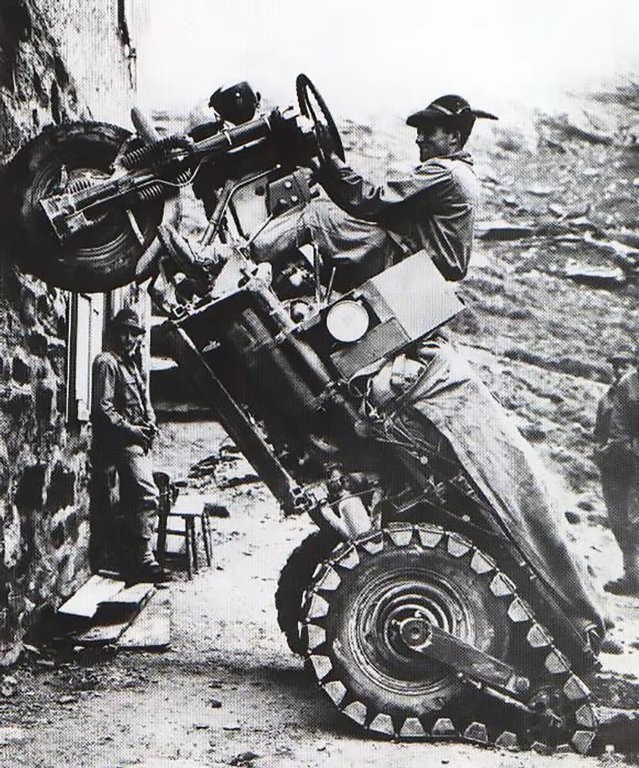
Collaboration between Moto Guzzi and the Italian Armed Forces began as early as the 1920s, later becoming a regular supply relationship in both peacetime and wartime. Existing production models were modified to meet military requirements, while several motorcycles were designed exclusively for the Italian Army, including the GT 17, the Alce, the Trialce and the Superalce.
In the early 1950s, Colonel Ferruccio Garbari, drawing on his experience in the Technical Service of the Military Motorisation Corps, began developing an innovative transport vehicle for Alpine troops that could overcome the limitations of pack animals, initially working alongside them before eventually replacing them.
Moto Guzzi’s Mandello factory was soon involved in the project and was given three key requirements: three driven wheels, adjustable track width, and a payload capacity of at least 500 kilograms. It was an extremely demanding challenge that brought together some of the company’s finest engineers, including Antonio Micucci, designer of the Guzzino, and even Giulio Cesare Carcano, who, following the premature retirement of his Eight-Cylinder racing project, was awaiting a new engineering assignment.
The result was a V-twin engine that, in many ways, anticipated what would later become one of Moto Guzzi’s defining trademarks. The remainder of the vehicle was an engineering masterpiece: a mechanical mule capable of climbing gradients exceeding 42% in second gear, while in first gear its only real limitation was the available ground traction. Snow and mud posed little obstacle once tracks were fitted, and even narrow mountain mule tracks could be negotiated thanks to its adjustable rear track width.
Was it a success? Not entirely. The vehicle was prone to lateral rollovers, demanded considerable driving skill that made it suitable only for experienced operators, required complex maintenance, and incurred high operating costs.
Production ended after just 200 units had been built. What never faded, however, was the affection and admiration the vehicle continues to inspire among past and present members of the Alpini. It remains one of the stars of their gatherings and reunions.