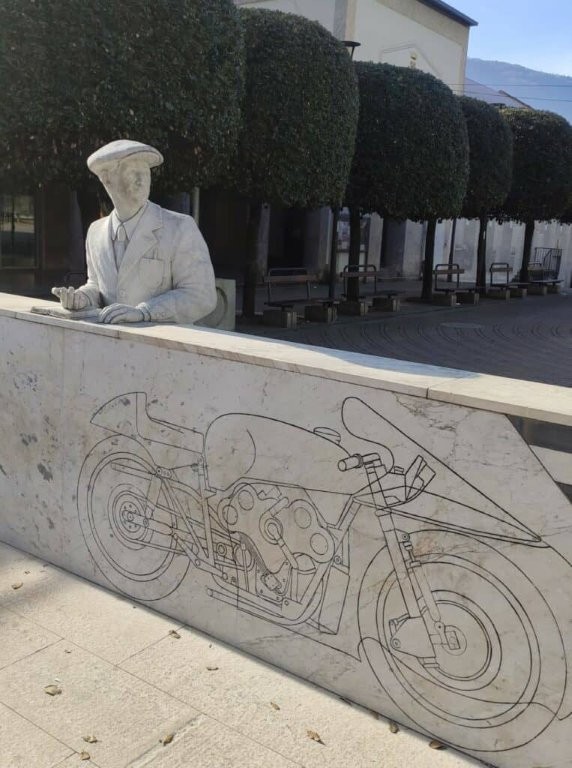
In Mandello del Lario, in front of the Town Hall, stands a long slab of white marble: the Monument to Carlo Guzzi, created by the sculptor Ettore Gambioli. Symbolically leaning against the pit wall, Guzzi is depicted recording the lap times of the Eight-Cylinder racing motorcycle. Piazza Leonardo da Vinci is an essential pilgrimage destination for every devoted admirer of the brand.
The Eight-Cylinder remains a racing motorcycle that, even after so many decades, continues to fascinate and astonish. Yet Carlo Guzzi was neither its creator nor its godfather. From 1951 onwards, the design of Moto Guzzi’s racing motorcycles was no longer his responsibility. Shortly afterwards, a dedicated racing department was established under the leadership of engineer Giulio Cesare Carcano, who had been recruited at a young age before the war through the foresight of Giorgio Parodi.
The story of the Eight-Cylinder is, above all, the story of the Parodi family, who approved a hugely ambitious and costly project at a time when the single-cylinder racing machines, although as light as a feather and developed to their absolute limit, could no longer match the pace of Gilera’s four-cylinder motorcycles.
Less than a year passed between the first sketch and the public start-up of the completed machine. The engine itself was ready in only five months. The workers nicknamed it “the spaceship”, yet Umberto Todero from Friuli, who transformed Carcano’s ideas into detailed drawings, always described it as a straightforward engine, miniaturised in some of its components, but simple to service, even during race-day work in the pits.
The motorcycle first took to the track in 1955 and, inevitably, suffered a succession of retirements, often for relatively minor mechanical issues. At the same time, however, the soundness of the design was never in doubt, and development focused solely on refinement and improvement.
The 1957 season began with two victories, proving that the motorcycle was now capable of winning. Soon afterwards, however, the team was severely weakened by a series of injuries, compounded by the fact that many riders were competing in multiple racing classes, where competition was exceptionally fierce. In September, at Monza, no rider was available. Veteran racer Alano Montanari, who knew the machine well, offered to compete, but the team management, concerned by his fearless and aggressive riding style, declined his offer.
At the end of the year came the announcement that brought Moto Guzzi’s factory racing programme to a close.
It is said that the gods favour heroes destined for a short life. The Eight-Cylinder, too, is cherished by generations of enthusiasts, who are captivated every time its extraordinary engine is brought to life in public.