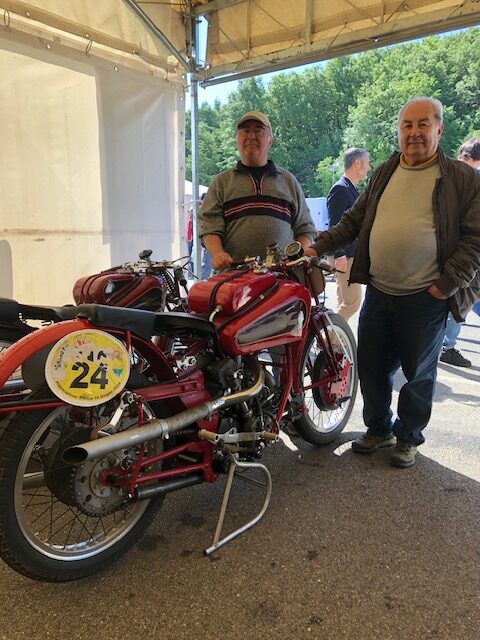
After nine years of outstanding success, the Moto Guzzi 500 C 4V single-cylinder was no longer able to match the performance of its competitors. Yet it was this very motorcycle that had inaugurated the company’s Roll of Honour by winning the first European Championship at Monza in 1924. For Carlo Guzzi, it was a difficult moment on a personal level, as it meant finally setting aside the racing motorcycle that most faithfully embodied his original engineering vision.
He faced no such hesitation when designing its successor, once again following his instinct as an innovator while remaining faithful to a number of non-negotiable principles. We are used to associate Moto Guzzi with its iconic horizontal single-cylinder engine, and that is precisely where he began. Starting from the 250 cc racing engine, he added a second identical cylinder positioned at 120 degrees to the first, creating an entirely new twin-cylinder engine with a strikingly aggressive mechanical appearance and immediate competitive potential.
The new engine proved so effective and reliable that it became the team’s mainstay both on racing circuits and in gruelling endurance events such as the Milan–Naples race. It was ridden to victory by champions including the British rider Stanley Woods and the Italians Bandini, Sandri, Pigorini, Balzarotti, and above all Omobono Tenni.
Tenni, from Treviso and not yet an official factory rider, was entrusted with the brand-new twin-cylinder for the Italian Grand Prix in Rome as a test of his abilities. He immediately took the lead, but after only a few laps crashed heavily, seemingly jeopardising his chance of joining the factory team. Instead, he would more than repay the faith placed in him, achieving many of his greatest successes aboard the twin-cylinder, including a final attempt many years later to win another Tourist Trophy on the Isle of Man.
The 1948 TT proved to be his final race. After setting the fastest lap, the twin-cylinder machine retired with mechanical failure. The racing career of this remarkable engine nevertheless continued until 1951, when it claimed its final victory with Enrico Lorenzetti. During its eighteen-year competitive life, the engine underwent continual refinement but never any radical redesign — Carlo Guzzi simply would not allow it.
Where engineers enjoyed greater freedom was in the chassis. The motorcycle was originally built without rear suspension, but in 1935 it became the first racing motorcycle to feature a sprung rear frame. Credit for this innovation belongs to engineer Giuseppe Guzzi, who conceived the idea during his long-distance journeys before introducing it first on the company’s production motorcycles.